
Machine Translation Performance Leaderboard
Translation quality of 63 models on classical Asian languages → English.
Language pairs: Tibetan → English (bo-en) · Sanskrit → English (sa-en) · Chinese → English (zh-en).
- Elo (the headline number) — the same idea as chess ratings. A 100-point gap means the higher-rated model is picked over the lower-rated one about 64% of the time; 200 points means about 76%. The average model in the field sits at 1500. The ± range shown when you click a row is a 95% confidence interval.
- Which sentences? 100 sentences chosen to discriminate. These corpora are full of formulaic passages that every model renders identically — comparing on those is a coin flip. We kept only sentences where models actually diverge, dropped anything whose reference text repeats elsewhere in the test set, and balanced the selection across the three language pairs.
- BLEU, chrF, BLEURT — the older reference-overlap metrics, still computed for every model and shown in the row breakdown and the heatmap below. BLEURT compares meaning against the reference, BLEU counts word overlap, chrF counts character overlap.
Leaderboard
| # | Model | Elo | Tibetan | Sanskrit | Chinese |
|---|---|---|---|---|---|
| 1 | MITRA-QWEN 9B (closed-book) | 1812 | 1876 | 1862 | 1764 |
| 2 | gemini-3.6-flash | 1781 | 1829 | 1833 | 1746 |
| 3 | gemini-3.7-flash | 1778 | 1841 | 1830 | 1727 |
| 4 | gemini-3-flash-preview-tb32 | 1726 | 1742 | 1776 | 1720 |
| 5 | gemini-3.5-flash-tb32 | 1715 | 1773 | 1751 | 1680 |
| 6 | gemini-3.1-flash-lite-tb32 | 1701 | 1747 | 1732 | 1681 |
| 7 | stage2-6145-grpo100-native | 1663 | 1746 | 1757 | 1556 |
| 8 | gemini-3.5-flash | 1652 | 1672 | 1622 | 1709 |
| 9 | gemini-3.5-flash-lite | 1651 | 1690 | 1716 | 1604 |
| 10 | gemini-2.5-flash-tb32 | 1581 | 1640 | 1592 | 1556 |
| 11 | Qwen3.5-122B-A10B | 1548 | 1586 | 1428 | 1642 |
| 12 | gemini-2.0-flash | 1542 | 1614 | 1545 | 1508 |
| 13 | gemini-2.0-flash-lite | 1514 | 1571 | 1502 | 1500 |
| 14 | gemma-4-31b-it | 1502 | 1542 | 1415 | 1556 |
| 15 | gemma-2-mitra-it-basic-temp02 | 1484 | 1546 | 1454 | 1474 |
| 16 | gemini-2.5-flash-lite | 1470 | 1554 | 1418 | 1454 |
| 17 | Qwen3.5-27B | 1467 | 1432 | 1351 | 1594 |
| 18 | Qwen3.5-35B-A3B-FP8 | 1463 | 1438 | 1370 | 1566 |
| 19 | mitra-madlad-3b | 1459 | 1565 | 1468 | 1374 |
| 20 | gemma-4-26B-A4B-it | 1386 | 1423 | 1253 | 1446 |
| 21 | Qwen3.5-9B | 1302 | 1144 | 1193 | 1453 |
| 22 | Hy-MT2-30B-A3B FP8 (direct) | 1270 | 1095 | 1245 | 1375 |
| 23 | gemma-4-12B-it-vanilla-temp02 | 1240 | 1198 | 1132 | 1312 |
| 24 | gemma-4-E4B-it-vanilla-temp02 | 1200 | 1284 | 1029 | 1198 |
| 25 | gemma-3-12b-it | 1194 | 1142 | 1096 | 1258 |
| 26 | Qwen3.5-4B | 1194 | 972 | 1016 | 1381 |
| 27 | translategemma-12b-it | 1171 | 1082 | 1024 | 1282 |
| 28 | Hy-MT2-7B (direct) | 1160 | 1030 | 1044 | 1277 |
| 29 | gemma-2-9b-it-vanilla-temp02 | 1157 | 1054 | 1103 | 1221 |
| 30 | Qwen3-8B | 1139 | 843 | 1105 | 1270 |
| 31 | Hunyuan-MT-7B (direct) | 1098 | 938 | 850 | 1275 |
| 32 | gemma-4-E2B-it-vanilla-temp02 | 1087 | 1152 | 921 | 1070 |
| 33 | Hy-MT2-1.8B (direct) | 1031 | 892 | 977 | 1095 |
Tip: click a row to see Tibetan / Sanskrit / Chinese results for that model.
Provenance note: the row marked “live API” — MITRA (gemini-3-flash-preview,
live API) — is the only run measured end-to-end against the deployed dharmamitra translation
API (server-side retrieval, prompting and generation, i.e. exactly what dharmamitra.org users
get). All other MITRA rows replicate the production pipeline in the standalone evaluation harness
(mitra-evaluation) and call the model APIs directly; the remaining rows are the raw
models under the harness's own prompting.
High thinking budget (tb = 1024)
| # | Model | Elo | Tibetan | Sanskrit | Chinese |
|---|---|---|---|---|---|
| 1 | gemini-3-flash-preview-tb1024 | 1726 | 1721 | 1801 | 1719 |
| 2 | gemini-2.5-flash-tb1024 | 1610 | 1671 | 1640 | 1571 |
Retrieval-augmented (RAG / ICL)
| # | Model | Elo | Tibetan | Sanskrit | Chinese |
|---|---|---|---|---|---|
| 1 | MITRA (gemini-3.7-flash) | 1834 | 1862 | 1881 | 1823 |
| 2 | MITRA-QWEN 9B (knn-ICL) | 1808 | 1831 | 1929 | 1742 |
| 3 | gemini-3.1-flash-lite-tb32-primary-rag-n3 | 1754 | 1792 | 1776 | 1752 |
| 4 | stage2-6145-tr10st-bm25 | 1734 | 1789 | 1805 | 1676 |
| 5 | Qwen3.5-122B-A10B (knn-RAG) | 1691 | 1726 | 1774 | 1637 |
| 6 | MITRA-knn RL (gemma-2-9B, SFT+GRPO) | 1672 | 1729 | 1728 | 1619 |
| 7 | MITRA-BM25 RL (gemma-2-9B, SFT+GRPO) | 1653 | 1710 | 1725 | 1586 |
| 8 | gemma-4-26B-A4B-it-knn-rag-temp02 | 1627 | 1665 | 1690 | 1582 |
| 9 | MITRA-knn SFT (gemma-2-9B, ckpt-10) | 1614 | 1718 | 1653 | 1531 |
| 10 | gemma-4-12B-it-knn-rag-temp02 | 1555 | 1568 | 1654 | 1496 |
| 11 | gemma-4-E4B-it-knn-rag-temp02 | 1518 | 1556 | 1630 | 1419 |
| 12 | gemma-3-12b-it (BM25-RAG) | 1509 | 1566 | 1616 | 1396 |
| 13 | Qwen3.5-4B (knn-RAG) | 1483 | 1426 | 1597 | 1458 |
| 14 | gemma-2-9b-it-knn-rag-temp02 | 1450 | 1445 | 1639 | 1305 |
| 15 | Qwen3-8B (knn-RAG) | 1444 | 1348 | 1595 | 1406 |
| 16 | gemma-4-E2B-it-knn-rag-temp02 | 1401 | 1393 | 1567 | 1264 |
Retrieval is decontaminated against the evaluation sets — near-duplicate source/target pairs were removed from the index, since 81% of the Tibetan test rows were originally present in it near-verbatim.
Scored, but not in the arena
| # | Model | BLEURT (0–100) | Tibetan | Sanskrit | Chinese |
|---|---|---|---|---|---|
| 1 | MITRA (gemini-3-flash-preview, live API) | 0.590 | 0.594 | 0.579 | 0.597 |
| 2 | MITRA (gemini-3.1-flash-lite) | 0.589 | 0.602 | 0.575 | 0.589 |
| 3 | MITRA (gemini-3.5-flash) | 0.588 | 0.591 | 0.578 | 0.595 |
| 4 | gpt-5.5 | 0.575 | 0.573 | 0.552 | 0.601 |
| 5 | claude-opus-4-8 | 0.571 | 0.574 | 0.549 | 0.592 |
| 6 | gpt-5.4 | 0.566 | 0.568 | 0.540 | 0.589 |
| 7 | claude-sonnet-4-6 | 0.561 | 0.560 | 0.539 | 0.583 |
| 8 | gpt-5.4-mini | 0.559 | 0.564 | 0.527 | 0.585 |
| 9 | grok-4.2 | 0.557 | 0.560 | 0.534 | 0.578 |
| 10 | grok-4.3 | 0.551 | 0.555 | 0.522 | 0.575 |
| 11 | gpt-4.1 | 0.549 | 0.532 | 0.531 | 0.585 |
| 12 | claude-haiku-4-5 | 0.534 | 0.535 | 0.500 | 0.567 |
Sanskrit → Japanese (contextual, passage-level)
| # | Model | GEMBA (1–100) | BLEU | chrF |
|---|---|---|---|---|
| 1 | gemini-3-flash-preview (BM25 EN+JA) | 91.17 | 26.73 | 33.22 |
| 2 | gemini-3.5-flash (BM25 JA) | 90.90 | 29.53 | 35.43 |
| 3 | gemini-3-flash-preview (BM25 JA) | 90.89 | 26.04 | 32.63 |
| 4 | gpt-5.5 (BM25 JA) | 90.69 | 24.60 | 31.86 |
| 5 | claude-opus-4-8 (BM25 JA) | 90.44 | 34.63 | 39.44 |
| 6 | gemini-3-flash-preview (BM25 EN) | 90.05 | 18.80 | 26.69 |
| 7 | gemini-3-flash-preview | 89.97 | 18.93 | 26.78 |
| 8 | gpt-5.4 (BM25 JA) | 89.87 | 22.51 | 30.26 |
| 9 | gemini-3.5-flash | 89.72 | 19.73 | 27.67 |
| 10 | claude-sonnet-4-6 (BM25 JA) | 89.13 | 29.98 | 35.72 |
| 11 | claude-opus-4-8 | 89.01 | 19.28 | 27.64 |
| 12 | gpt-5.5 | 88.98 | 19.74 | 28.10 |
| 13 | gemini-3.1-flash-lite (BM25 JA) | 88.07 | 26.08 | 32.84 |
| 14 | gpt-5.4 | 87.44 | 17.92 | 26.58 |
| 15 | gemini-3.1-flash-lite | 85.61 | 16.44 | 25.02 |
| 16 | claude-sonnet-4-6 | 84.31 | 16.12 | 24.93 |
| 17 | gpt-5.4-mini (BM25 JA) | 78.93 | 19.65 | 27.84 |
| 18 | gpt-5.4-mini | 75.12 | 15.31 | 24.16 |
| 19 | claude-haiku-4-5 (BM25 JA) | 71.63 | 25.88 | 31.85 |
| 20 | claude-haiku-4-5 | 56.13 | 11.31 | 20.22 |
| 21 | Qwen3.5-9B (base) | 33.22 | 6.01 | 14.11 |
| 22 | Qwen3.5-9B sa→ja SFT (ours) | 30.59 | 8.24 | 16.70 |
Vanilla = zero-shot; BM25 = retrieval-augmented (per-sentence, k=2). JA / EN / EN+JA = language(s) of the retrieved reference examples.
Per-language detail (raw scores)
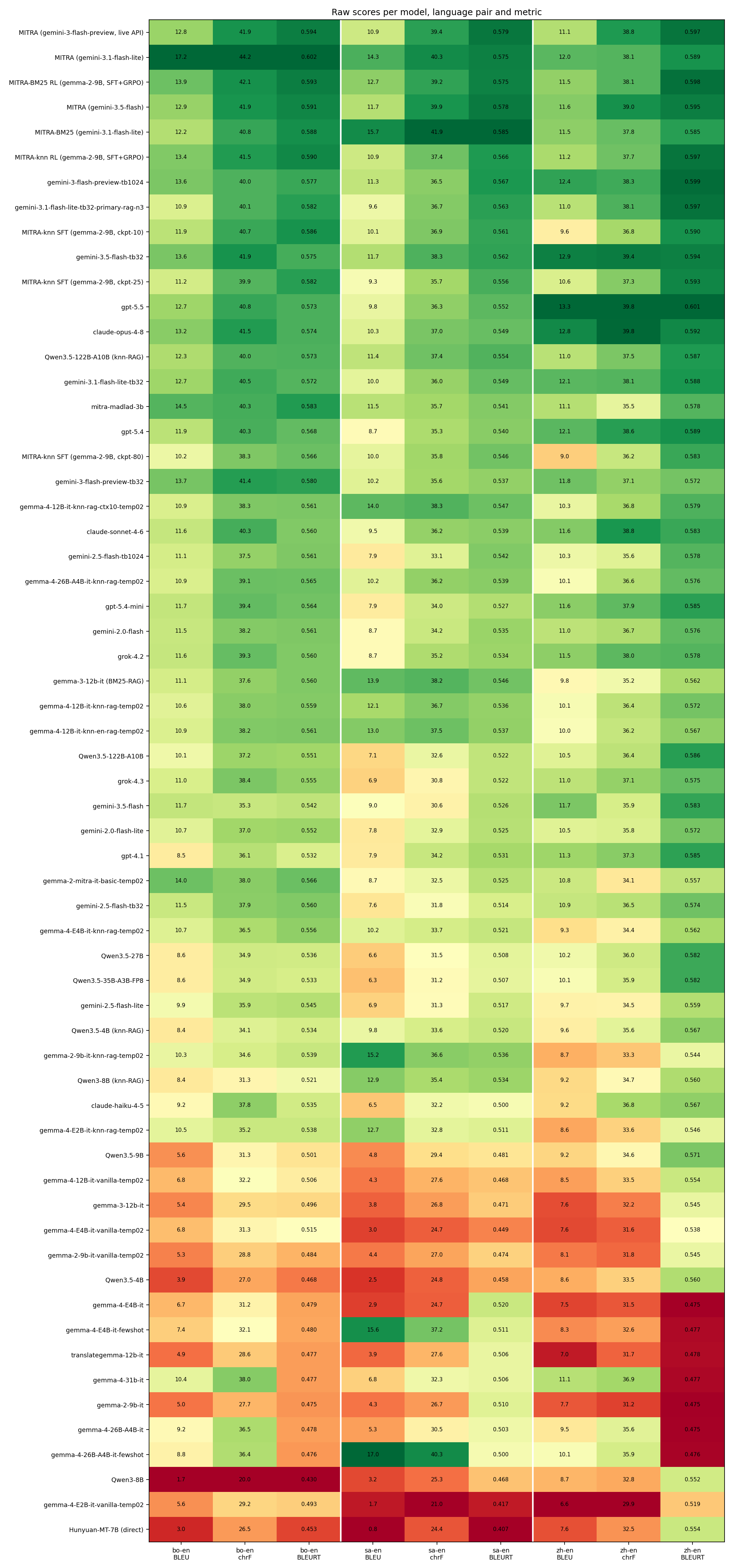
- Tibetan → English — 4,051 sentences from an unpublished internal held-out set, sampled across the full data distribution.
- Sanskrit → English — 5,552 sentences from the Mitrasaṃgraha held-out set (dharmamitra/mitrasamgraha-dataset).
- Chinese → English — 2,709 sentences from the MITRA-zh-eval Buddhist Chinese benchmark (Nehrdich et al., NLP4DH 2025).
The arena. Ratings come from 122,500 head-to-head comparisons: all 1,225 pairs of the 50 rated models, each judged on the same 100 items, by gemini-3.1-flash-lite shown the source, the human reference and both translations. Presentation order is randomized per comparison so that position preference cancels rather than favouring whoever is listed first. Ratings are fitted by Bradley–Terry maximum likelihood — the order-independent form of Elo — and confidence intervals come from resampling items, which is the unit that actually varies. Two limits worth knowing: the judge is itself a Gemini model and most of the top-rated systems are Gemini-generated, so same-family preference cannot be ruled out; and the judge picks the first-shown translation about 54.5% of the time, which randomization spreads evenly across models but does not eliminate.
Reference metrics. Corpus BLEU and chrF (sacreBLEU) and BLEURT-20 are computed for every model and shown in the heatmap above and each model’s row detail. GEMBA is excluded (the upstream LLM-judge endpoint is currently unavailable). In the score-only table, BLEURT is shown as a relative 0–100 score (min–max normalized across every model on this page, so 100 is the best-scoring model anywhere here) so the closely-spaced raw values are easier to read; the underlying BLEURT-20 scores span roughly 0.47–0.60 and appear raw in the heatmap and row detail.
Retrieval-augmented entries. Entries marked mitra-* or *-knn-rag-* retrieve reference translations from the production index at inference time. On 2026-06-12 the index was found to contain near-duplicates of parts of the Tibetan (81% of rows) and Chinese (20%) test sets and was decontaminated; *-knn-rag-temp02 entries are scored against the cleaned index, while the older MITRA (…) rows predate the cleanup and their Tibetan/Chinese scores are likely inflated (see mitra-rag-mt
evaluation/notes/2026-06-12-mitra-pipeline-eval.md).